StandFinder Field Notes
Roadside farmstand signs: a safe, practical marketing guide
Build a simple, readable sign system that helps drivers notice a farmstand, find the correct entrance, understand open status, and stop without creating a roadside hazard.
In this guide · 18 sections
A roadside farmstand sign has only a few seconds to do its work. A driver must notice it, understand the message, decide whether to stop, find the correct entrance, and leave the roadway safely. More words, brighter colors, and larger boards do not automatically improve that sequence.
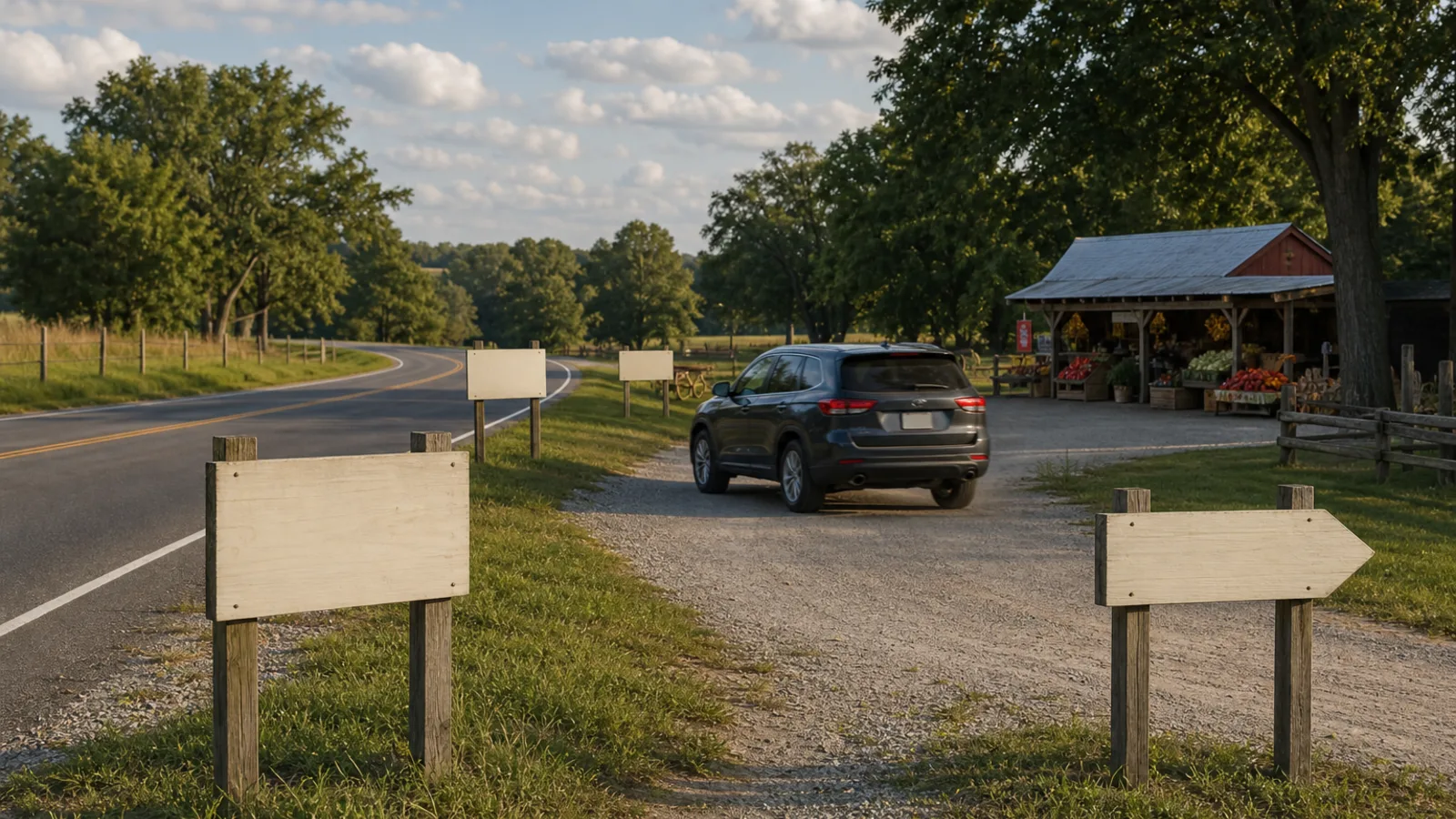
Effective signs form a small wayfinding system: advance notice, a clear entrance marker, an open or closed signal, and simple product and price information at the stand. This guide focuses on making that system legible, maintainable, neighbor-friendly, and honest.
Put safety and permission before promotion
Before making a sign, verify where it can legally be placed. State, county, municipal, road authority, zoning, subdivision, utility, and property rules may control sign size, height, setback, lighting, movement, temporary banners, sight lines, and placement in a public right-of-way.
Never assume the grass beside a road belongs to the farm. Signs in a shoulder, drainage area, utility corridor, or intersection sight triangle can create hazards and may be removed.
Evaluate the entrance itself. A sign cannot make an unsafe turn safe. Drivers need adequate sight distance, space to slow without surprising following traffic, a stable pull-off, and room to exit. Consult the responsible road authority or a qualified professional when access is uncertain.
Do not encourage visitors to stop, reverse, cross lanes, or park on the shoulder. If safe access cannot be provided, use preorder pickup at another permitted location or a different sales channel.
Give each sign one job
A roadside system works better when information is divided by decision.
Advance sign: tells a driver that a farmstand is ahead and gives one memorable reason to consider stopping.
Entrance sign: confirms the exact turn with a clear directional cue.
Open sign: communicates whether a visit is useful now.
Stand sign: explains products, prices, payment, and customer instructions after the vehicle is safely parked.
Trying to fit the farm name, eight products, hours, a web address, payment methods, growing practices, and an arrow on the advance sign usually makes all of it unreadable.
Write the purpose on masking tape behind each board. If a proposed line does not help that purpose, move it to the listing, stand, or receipt.
Read the road at driving speed
Walk the property first, then drive past as a passenger in both directions at the normal legal speed. Notice curves, hills, trees, mailboxes, existing signs, sun glare, snow storage, tall crops, and seasonal foliage.
Count how long the intended sign location is visible before the entrance. A board may look large from the ditch and disappear behind vegetation from a vehicle. Check morning and afternoon light.
Take video only from a securely mounted device or have a passenger record. Do not hold a phone while driving. Review the approach later to identify which information is visible and where the entrance becomes obvious.
Place permitted signs so they do not block official traffic signs, pedestrians, cyclists, driveways, or a neighbor's view. Maintain vegetation on the farm's property without altering public land or utilities.
Use fewer words and larger letters
Drivers cannot read a farmstand brochure. A practical advance message may be:
FARMSTAND
SWEET CORN
AHEAD
The exact wording depends on the product and applicable rules, but the principle is one short idea per line. Use familiar terms instead of clever phrases that require interpretation.
Letter height, typeface, contrast, spacing, speed, and viewing distance work together. Obtain current local sign guidance rather than relying on a universal size claim. When in doubt, test larger letters and fewer words from the actual road.
Use uppercase selectively. It can make a short word strong, while mixed case may improve recognition of longer phrases. Avoid thin scripts, condensed decorative fonts, outlines, and drop shadows that disappear at distance.
Build strong contrast
Dark letters on a light plain background or light letters on a dark plain background are usually easier to read than several similar colors. Deep green on cream, black on white, or cream on a dark board can suit a farm setting without sacrificing contrast.
Photograph the sign in grayscale. If letters and background blend, color alone is doing too much work. Check in sun, shade, rain, and dusk.
Do not place text over wood grain, produce illustrations, photographs, or complex patterns. Decorative borders should remain far enough from letters to preserve white space.
Reflective materials or lighting may be regulated and must not create glare. Avoid flashing, moving, scrolling, or intensely bright signs near a roadway unless expressly allowed and professionally designed for the context.
Make the entrance cue unmistakable
The entrance marker should be close enough to confirm the turn without asking a driver to react at the last instant. Use a simple arrow or directional shape that cannot be confused with an official traffic sign.
Point the arrow toward the actual safe customer entrance, not toward the stand across a ditch or fence. If traffic approaches from both directions, evaluate each approach separately. One sign may not serve both.
Keep the entrance clear of display tables, people, animals, and parked cars. The sign should guide vehicles into a defined parking area before anyone begins shopping.
Use a second confirmation sign inside a long driveway when the route is not obvious. Mark private or farm-work lanes so visitors do not wander into equipment areas.
Make open and closed status truthful
Few experiences damage trust faster than an “OPEN” sign beside a closed or empty stand. Assign opening and closing signs to the checklist, not to memory.
A reversible board, flag, gate marker, or simple panel can communicate status. Choose a system that will not blow around or appear open from the wrong side.
If the stand is honor-system and stocked during specific hours, communicate those hours consistently. “Open daily” should not mean “possibly stocked.” Update temporary closures for heat, weather, harvest, or family needs at the road and in the StandFinder listing.
Remove or cover seasonal signs when the stand closes for the year. A faded pumpkin sign in spring suggests the farm's information is not maintained.
Lead with one real anchor product
A product sign works when it gives a relevant reason to stop today. Choose an anchor with dependable supply: strawberries, sweet corn, peaches, tomatoes, eggs, pumpkins, or another locally important item.
Do not advertise a product that sold out yesterday or may appear next week. Build interchangeable panels so the message changes with actual inventory.
Avoid a list of every possible crop. At driving speed, “TOMATOES” communicates more than “tomatoes, zucchini, basil, cucumbers, carrots, beets, flowers, honey, jam.” The full selection belongs on the stand and online.
If partner products are advertised, represent the source accurately. “Local bread” and “baked here” are different claims.
Separate roadside signs from price signs
Drivers should not be calculating unit prices before turning. Put detailed price information where customers are parked and can read without pressure.
At the display, each product needs a clear name, price, and unit such as per pound, bunch, pint, dozen, or piece. Keep signs physically close to the correct item. If a commercial scale is used, follow applicable weights-and-measures requirements.
Use consistent card sizes, lettering, and holders. Replace stained, curled, or outdated cards. A handwritten style can feel personal, but legibility comes first.
For changing prices, use replaceable inserts or a clean board instead of layers of crossed-out numbers.
Choose materials for the actual weather
Exterior signs face ultraviolet light, rain, frost, wind, road spray, dust, mowing, and sometimes snowplows. Select materials, posts, coatings, hardware, and anchors suited to the expected season and local rules.
Plywood edges and unsealed holes absorb water. Thin plastic flexes and fatigues. Lightweight sandwich boards can become hazards in wind. Rough wood may splinter and makes repainting difficult.
Round sharp corners, recess or cap fasteners, and inspect posts for rot. Set structures without damaging utilities; use the local utility-marking service before digging.
Temporary signs still need secure installation. Do not attach signs to utility poles, road signs, trees, fences, or structures without permission.
Keep a repair kit with matching paint, blank panels, approved hardware, and a photograph of the intended layout. Consistency is easier when the standard is documented.
Design for rain, dusk, and seasonal change
Water can darken a board, reduce contrast, and collect on horizontal ledges. Snowbanks can bury low signs. Summer leaves can cover a view that was clear in March.
Inspect after significant weather and at least monthly during the season. Clean road film, tighten hardware, trim permitted vegetation, and remove insect nests safely.
If the stand operates near dusk, evaluate whether the entrance and parking are visible without creating glare. Lighting should illuminate the customer area, not shine into traffic or neighboring homes. Confirm electrical and sign rules.
Do not rely on a solar garden light to make a road sign readable. If nighttime access cannot be made safe, close before dark and state the hours.
Coordinate physical and digital wayfinding
A customer may see the sign, search the farm name, open a map, and compare the listing image before turning. The information should agree.
Use the same farm name and current hours at the road, on the stand, and in the listing. Place the map pin at the customer entrance. Include a current photograph of the approach and parking.
A short memorable farm name is easier to search than a long website URL printed on a moving-road sign. QR codes belong at the parked shopping area, not where drivers are expected to scan them.
On the StandFinder marketplace, list the anchor products currently advertised. Remove sold-out products or add a dated availability note.
Respect neighbors and the landscape
Signs change how a road and neighboring properties feel. Tell adjacent neighbors before adding large, lit, or event signs. Keep boards on permitted property and prevent customer vehicles from blocking driveways, mailboxes, field entrances, or sight lines.
Avoid sign clutter. Five small boards may create more visual impact and less understanding than two strong ones. Remove temporary event arrows immediately afterward.
Manage litter around sign locations and retrieve storm-damaged pieces. Do not let ties, plastic panels, or broken stakes enter fields or drainage.
If customers repeatedly turn into a neighbor's lane, the problem is not their failure to read. Improve entrance confirmation, the map pin, and written directions.
Include shoppers who are not reading from a car
Some visitors arrive on foot, bicycle, mobility device, farm tour shuttle, or community transport. Keep pedestrian paths separate from turning vehicles where possible and provide a sign at eye level in the customer zone.
Use large print, strong contrast, plain language, and symbols paired with words. Provide a reachable price list or assistance option if display signs are high or distant.
Do not use color alone to communicate open, closed, or direction. Shape and text should carry the meaning as well.
Describe gravel, slopes, steps, narrow paths, and pickup alternatives in the listing so customers can plan.
Test signs with unfamiliar people
Owners already know the entrance and mentally fill in missing information. Ask someone who has never visited to approach as a passenger and describe:
- When they first noticed the stand
- What product they understood was available
- Where they believed the entrance was
- Whether open status was clear
- Where they expected to park
- What confused them
Do the test from both directions and at the actual time of operation. Do not coach the person during the approach.
At the stand, ask a different tester to find the price, unit, payment instructions, and exit. Correct the system before increasing promotion.
Measure what the system changes
Track common arrival problems before and after an update:
- Vehicles missing the entrance
- Unsafe slowing or shoulder stops
- Customers entering the wrong driveway
- Messages asking whether the stand is open
- Complaints from neighbors
- Direction requests in the listing
- Visits mentioning the anchor-product sign
Safety observations matter more than raw traffic. A campaign that increases visits but creates dangerous turns is not successful.
Record sign content and placement with dated photographs. When sales change, note weather, inventory, and hours so the sign is not credited for every difference.
A practical starter sign system
A first season usually needs fewer pieces than expected:
- One permitted advance sign for each safe approach that needs it
- One unmistakable entrance marker
- One maintained open or closed indicator
- One welcome and payment board at the stand
- A set of consistent product and price cards
- One private-area or exit marker if the site is confusing
Use replaceable product panels and avoid permanent wording for seasonal details. Store signs dry and flat during the off-season.
Budget for permission, design, durable material, installation, and maintenance—not only paint.
A sign is a promise
A clear roadside sign promises that the farmstand is where it says, open when it says, and offering what it says. The physical stand must keep that promise with safe access, current products, clear prices, and a maintained customer area.
Start with the road and entrance, verify rules, reduce the words, increase contrast, and test from an unfamiliar visitor's perspective. Then support the signs with an accurate grower listing and current photos. The best system does not shout the loudest. It makes the next safe decision obvious.